South Park: Phone Destroyer™
- 2.42K
- 4,6
- Installaties
- 10.00M
- Prijs
- Free

Schermafbeeldingen



Analyse door Reviewed
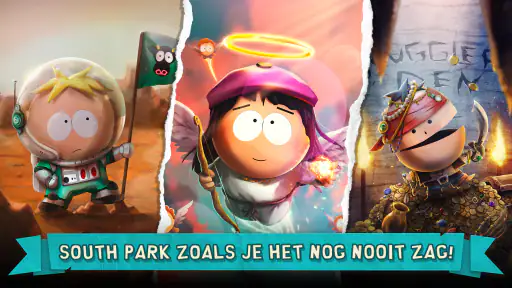
South Park: Phone Destroyer™ is a strategy game that mixes collectible cards, quick battles and the deliberately rude humor of the South Park universe. I found it most appealing when I wanted a match that felt more active than a traditional card game but less demanding than a long tactical session. The basic idea is easy to grasp: build a team from recognizable characters, place them at the right moment and try to push the fight in your favor. Behind that simple start sits a game that rewards timing, experimentation and a willingness to tolerate a lot of noise.
It is made by Ubisoft Entertainment and is free to download, although purchases inside the game range from €0,89 to €59,99 when billed through Google Play. The game carries a PEGI 16 age rating, which matters here because the comedy is intentionally crude and the presentation can be aggressive. Its average score is 4.6 from around 654 thousand ratings, and it has passed 10 million installs. Those figures suggest a large audience, but they do not automatically make it suitable for every player. My experience is that the strongest reason to try it is the combination of South Park’s personality and a surprisingly hands-on battle rhythm.
How the game reads and navigates in everyday play
Ik kijk in deze sectie naar hoe de drukke presentatie en de kaartkeuzes samenkomen tijdens gewone speelsessies. Een kleine voorbereiding kan daarbij meer verschil maken dan steeds sneller tikken: eerst herkennen wat je hand ongeveer biedt, daarna pas reageren op het slagveld. Dat brengt me bij de praktische gewoonten die het spel overzichtelijker maken.
A familiar card-battle structure with a lot of visual character
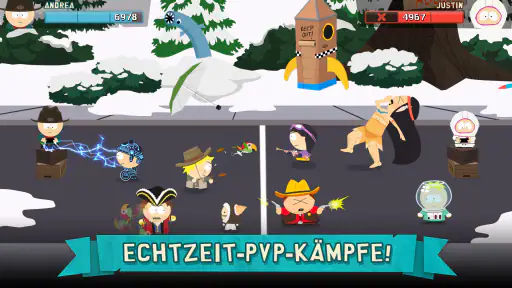
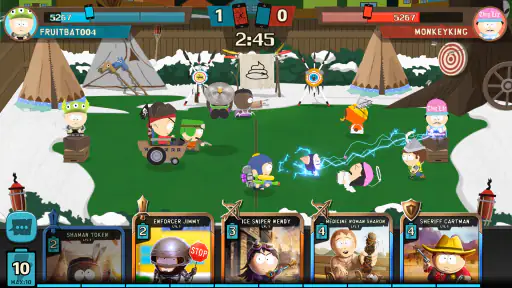
The first minutes are relatively approachable. The screen gives me a battlefield, a hand of available cards and a clear sense that every placement changes the situation. Characters move forward, attack targets and create small moments that are easy to follow when the action is not too crowded. The South Park art style helps recognition because the figures are visually distinct rather than realistic or heavily detailed. I can usually tell which character I am selecting by shape, color and animation before I have fully processed every label.
That visual clarity is useful, but it comes with a trade-off. The game is deliberately busy. Characters, effects, speech bubbles and movement compete for attention, especially when several units meet in the center. For a player who reads slowly, has difficulty tracking rapid animation or simply prefers calm interfaces, the presentation can become tiring. The humor also interrupts the tactical flow. I enjoy the jokes in moderation, yet during a close fight they can feel like extra information arriving when I am already trying to decide what to do.
The navigation makes the most sense once I stop treating every screen as equally important. I use the collection and deck-building areas for deliberate planning, then keep the battle screen for quick decisions. That separation is helpful because it prevents me from trying to solve strategic and interface questions at the same time. Before starting a serious session, I recommend spending a few minutes checking the cards and their roles. Knowing what each option is supposed to do reduces the need to read everything while a fight is already moving.
Why short preparation improves access
A useful habit is to create a simple mental grouping for the cards: units that hold the front, units that attack from a safer distance and cards that change the immediate situation. I do not need to memorize every detail to benefit from this. I only need a rough idea of what I am looking at when a card appears in my hand. This is particularly helpful for players who find rapid visual comparison difficult, because it turns a wall of individual choices into a few practical categories.
Meer van onze redactie
Ludo Club getest: leuk voor een snel potje, minder voor strategen
Candy Crush Saga en de lokroep van nog één poging

InShot maakt videomontage snel, maar niet altijd overzichtelijk

Telegram bouwt gemeenschappen, maar geen vertrouwen

Waarom Plants vs. Zombies™ een Strategisch Meesterwerk is

Waarom Microsoft Authenticator De Beste Keuze Is Voor Zakelijke Beveiliging
I also prefer playing with a consistent deck for a while instead of changing it after every loss. Constant rebuilding creates extra navigation and makes it harder to tell whether a problem came from the deck or from my timing. A stable setup gives me a clearer routine: select a card, place it, watch the result and adjust one decision at a time. That approach is less exciting than endlessly experimenting, but it makes the game easier to understand and more manageable for someone who needs repetition to build confidence.
The current version is 5.4.2 and it requires Android 7.0 or later. For someone deciding whether an older phone or tablet is suitable, that requirement is an important first check. I would also leave room for the possibility that the animated presentation feels less comfortable on a smaller display. I found that a larger screen makes it easier to distinguish units and follow the center of the battlefield, while a compact phone encourages me to play in shorter bursts.
Text, sound and the South Park presentation
The game’s identity depends heavily on voices, sound effects and fast visual reactions. That gives battles energy, but it means the experience is not equally comfortable in every setting. On public transport, in a waiting room or beside someone who is working, I would keep the sound low or off. The game remains understandable through its visual action, although some of its personality is lost when the audio is removed.
For players who rely more on text than audio, the visual feedback is usually enough to understand the immediate result of a move, but the screen can still become crowded. I would avoid playing while tired or distracted if reading small interface elements is difficult. The game asks me to notice a card, choose a location and monitor several moving characters at once. That is manageable in a quiet room, less so when I am switching attention between the game and other tasks.
Motor demands during battles
The controls are based on selecting and placing cards, which is simpler than a game that requires constant directional movement or complicated button combinations. That makes it approachable for players who prefer tap-based interaction. However, the timing still matters. A delayed tap can change the outcome, and a misplaced unit may be difficult to recover from. The physical action is not complex, but the pressure around it can be.
I noticed a clear difference between playing with one hand and using both hands. One-handed play is convenient when I am standing or holding a drink, but it also makes accidental taps and awkward reach more likely. With both hands available, I can focus on the battlefield and make more controlled selections. This is a small practical distinction, yet it affects comfort over a longer session.
Players with tremors, reduced precision or difficulty performing quick taps may find the game frustrating even if the basic controls are easy to understand. The challenge is not only reaching a button; it is reaching the right place at the right time. I would approach it as a game for deliberate short sessions rather than one that should be played while walking, carrying something or dealing with interruptions.
Attention, sound sensitivity and emotional comfort
The sensory load is part of the appeal for fans, but it can be a barrier for others. Bright effects, character movement, comic interruptions and sudden sounds create a lively surface. I like that energy when I am in the mood for it. When I want something quiet, predictable or relaxing, I choose another type of strategy game. This is not a criticism of the design so much as a clear difference in audience.
The humor deserves equal attention. South Park: Phone Destroyer™ is not a neutral cartoon strategy game. Its jokes can be vulgar, provocative and intentionally uncomfortable. The PEGI 16 rating is therefore more than a label to ignore. I would not hand it to a younger player simply because the characters look like paper cut-outs. Adults who dislike offensive comedy should also skip it, even if the battle system sounds appealing.
Where it fits, and where it creates friction
Hier weeg ik af wanneer de directe gevechten en de South Park-humor goed passen, en wanneer juist diezelfde eigenschappen in de weg zitten. Vooral het verschil tussen een korte, rustige speelsessie en spelen terwijl je wordt afgeleid, bepaalt hoe eerlijk de strategie aanvoelt. Daarna wordt duidelijk voor welke spelers die afweging de moeite waard is.
Situational access for short, interrupted sessions
One of the game’s practical strengths is that it works well as a focused break. I can play while waiting for an appointment or during a short rest, then stop before the session becomes too demanding. The structure suits people who enjoy making a few decisions at a time rather than committing to a long story chapter. That makes it easier to fit around an unpredictable day, provided I am not expecting every match to feel equally calm or brief.
A realistic example is a commute with a few minutes to spare. I can use that time to review my deck or play a battle, but I would not start when I know I will need to put the phone away immediately. The game rewards attention, and a sudden interruption can leave me feeling that I lost because of the situation rather than my strategy. In a quiet waiting area it works better than in a crowded street, where movement, noise and poor concentration all reduce control.
For people who need a break from visually intense games, this is not the obvious choice. The controls may be simpler than those of an action game, but the screen is still active and the humor is loud in its own way. A turn-based strategy title with a calmer interface may be more comfortable if the priority is low sensory demand. On the other hand, players who struggle with complicated control schemes may appreciate that the main interaction is based on clear card placement rather than a large set of simultaneous buttons.
Free entry, spending pressure and planning
The free price makes it easy to test the game without committing money at the start. That is useful for someone who is curious about the South Park style but unsure whether the strategy will hold attention. I would still recommend deciding on a personal spending limit before playing. The presence of optional purchases can change how the experience feels, especially for players who dislike being reminded that progress or collection growth can be accelerated by paying.
My preferred approach is to treat purchases as entirely optional and judge the game by what I can do without them. That keeps the focus on learning card interactions and improving decisions. It also reveals whether I enjoy the underlying loop rather than merely enjoying the novelty of unlocking something. Players who want a completely even, purchase-free competitive environment may be happier with a board-game adaptation or a premium strategy title that charges once at the beginning.
The game is a better fit for someone who likes gradual collection and repeated experimentation than for someone seeking a single, self-contained campaign. I enjoy testing a different combination and seeing how it changes the flow of a battle. If that kind of repetition feels like grinding, the South Park theme alone probably will not be enough to carry the experience.
What makes it different from ordinary strategy alternatives
Compared with a traditional turn-based strategy game, this one feels more immediate. I do not have unlimited time to examine a board and calculate every possibility. The battlefield keeps moving, so the important skill is often recognizing a useful response quickly. Compared with a conventional collectible card game, the cards do not remain abstract symbols for long: their characters enter the field and create a physical line of pressure that I can watch develop.
That hybrid design is the main reason I kept returning. It gives the satisfaction of deck planning without removing the tension of placement. It also means that players who prefer slow analysis may feel rushed, while players who find static card screens dull may find it more engaging. The South Park license is not just decoration; it shapes the tone, the jokes and the willingness to be ridiculous. Still, anyone who dislikes the show’s style should choose a different strategy game, because the humor is woven into the experience rather than placed at the edges.
Remaining barriers that deserve an honest warning
The biggest barrier is the combination of speed and clutter. Even when I understand what I want to do, I can lose track of the most important target when several effects appear together. A player with attention difficulties may need to use a quiet environment, take regular breaks and avoid playing when already overstimulated. There is no benefit in forcing a long session simply because the game is available.
Another barrier is the emotional effect of competitive losses. A close defeat can feel personal when I know one late decision changed the result. That tension is satisfying for some players, but unpleasant for others. I would skip this game if I wanted a reliably soothing experience or if losing in a collection-based strategy game tends to make me spend impulsively.
The age rating also limits who can comfortably play it around family or at work. The visual style may look harmless from a distance, but the tone is aimed at older players. I would use headphones only when appropriate and avoid assuming that a quiet setting makes the content suitable for everyone nearby.
There is also a learning barrier hidden behind the simple controls. Tapping a card is easy; understanding why a placement succeeded or failed takes longer. The game becomes more rewarding when I observe patterns instead of blaming luck. I pay attention to which unit reaches the fight first, whether I am spending cards too quickly and whether I am reacting to a threat or merely panicking. That reflective habit is one of the most useful ways to make progress without turning every session into a spending decision.
Who should install it, and who should pass?
I recommend it to South Park fans who enjoy strategy with a fast tempo, players who like building and testing teams, and people looking for a game that can fill a short break with meaningful decisions. It is especially suitable if you enjoy humor that is deliberately irreverent and do not mind learning through repeated matches. The free entry point makes trying it straightforward, as long as optional purchases are kept under control.
I would advise caution for anyone sensitive to crude comedy, rapid visual activity or competitive pressure. It is also a poor match for players who want a quiet puzzle, a slow tactical board or a premium game without purchase prompts. Someone with motor difficulties may find the timing demanding despite the simple tap-based controls, while someone with sensory sensitivities may prefer a less animated presentation.
My practical recommendation is to test it in a calm setting, with sound at a comfortable level, and to begin with a stable deck rather than changing everything after each loss. Give yourself time to learn the rhythm of placement. If the humor and visual intensity feel tiring before the strategy becomes interesting, that is a useful answer in itself.
My inclusive verdict
South Park: Phone Destroyer™ is a lively strategy game with an unusually strong personality. I like how it turns card choices into visible movement and immediate pressure, and I appreciate that the controls are easier to approach than those of many action games. Its accessibility in practice depends less on complicated buttons than on whether the player is comfortable with speed, visual clutter, sound and provocative comedy.
For me, the best experience comes in short, attentive sessions where I can see the battlefield clearly and think before placing a card. The game supports that context well, but it is not universally comfortable: crowded encounters, competitive tension, optional spending and the PEGI 16 tone all deserve consideration. I would recommend it to the right friend with that explanation attached, not as a harmless casual game, but as a sharp, noisy and entertaining strategy title that rewards patience beneath its chaotic surface.
Its strongest quality is the way it combines recognizable South Park humor with decisions that genuinely matter. Its main weakness is that the same energy can exclude players who need slower pacing, quieter presentation or more forgiving timing. If that trade-off sounds acceptable, the free download is a sensible way to discover whether the mix works for you. If your priority is calm, accessibility through simplicity or a completely self-contained strategy experience, another game will likely serve you better.
South Park: Phone Destroyer™ Veelgestelde vragen
Op welke apparaten en besturingssystemen kan ik South Park: Phone Destroyer™ spelen?
South Park: Phone Destroyer™ is een mobiele game voor Android en iOS. Voor Android is minimaal versie 7.0 vereist. Controleer vóór het downloaden of je apparaat aan die vereiste voldoet en voldoende ruimte heeft voor de installatie. De game is ontwikkeld door Ubisoft Entertainment en combineert strategie met personages en humor uit South Park.
Wat is South Park: Phone Destroyer™ precies voor game?
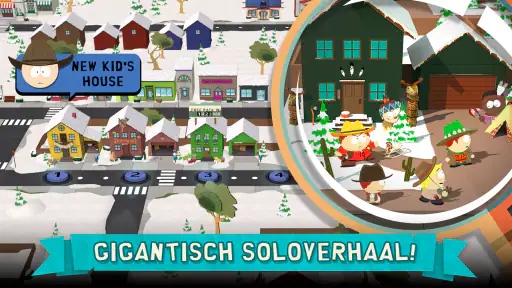
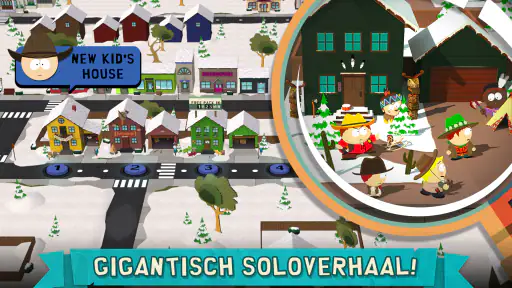
South Park: Phone Destroyer™ is een mobiele strategie- en kaartgame voor Android en iOS, gebaseerd op de bekende animatieserie. Je verzamelt kaarten met personages, spreuken en andere vaardigheden uit South Park en gebruikt die in realtimegevechten. De game combineert humor, een verhaalcampagne en speler-tegen-spelergevechten. Verwacht vooral satirische dialogen, absurde situaties en inhoud die duidelijk op een volwassen publiek is gericht.
Is South Park: Phone Destroyer™ gratis te downloaden en spelen?
Je kunt South Park: Phone Destroyer™ gratis downloaden en de basisgame zonder aankoop spelen. Wel bevat de game optionele in-appaankopen, met bedragen van € 0,89 tot € 59,99 bij facturering via Play. Daarmee kun je onder andere kaartpakketten, valuta of andere voortgangsitems aanschaffen. Betalen is niet noodzakelijk om de belangrijkste spelmodi te proberen. Ouders kunnen het verstandig vinden om aankoopbeperkingen op het apparaat in te stellen.
Heb je een internetverbinding nodig om te spelen?
Ja, voor South Park: Phone Destroyer™ is doorgaans een actieve internetverbinding nodig. De game maakt verbinding met online servers voor het laden van je account, het synchroniseren van voortgang, kaartupdates en multiplayergevechten. Daardoor is offline spelen meestal niet mogelijk of sterk beperkt. Op een instabiele verbinding kunnen wedstrijden bovendien vertraging oplopen of onverwacht worden beëindigd, vooral tijdens realtime PvP-gevechten.
Is de inhoud geschikt voor kinderen?
Hoewel South Park: Phone Destroyer™ kleurrijk en cartoonesk oogt, is de inhoud niet bedoeld voor jonge kinderen. De game heeft PEGI 16 en bevat grof taalgebruik, zwarte humor, geweld, volwassen grappen en satirische thema’s die rechtstreeks uit de televisieserie komen. Daarnaast zijn er in-appaankopen en onlinecompetitie aanwezig. Gebruik ouderlijk toezicht wanneer kinderen toegang tot het apparaat hebben.
Voordelen
- Grappige dialogen en satire die fans van South Park direct herkennen.
- Veel verschillende kaarten met unieke vaardigheden en speelstijlen.
- Regelmatige uitdagingen houden het verzamelen en upgraden interessant.
- Korte wedstrijden passen goed bij spelen onderweg.
- Sterke stemacteurs zorgen voor een authentieke South Park-ervaring.
Nadelen
- Vooruitgang kan traag voelen zonder regelmatig kaarten te upgraden.
- Sommige tegenstanders gebruiken zeer sterke kaartcombinaties.
- De humor is grof en niet geschikt voor jongere spelers.
- Een stabiele internetverbinding is nodig om te kunnen spelen.
- Veel meldingen en aanbiedingen kunnen na verloop van tijd storend worden.
- Categorie
- Strategie
- Versie
- 5.4.2